
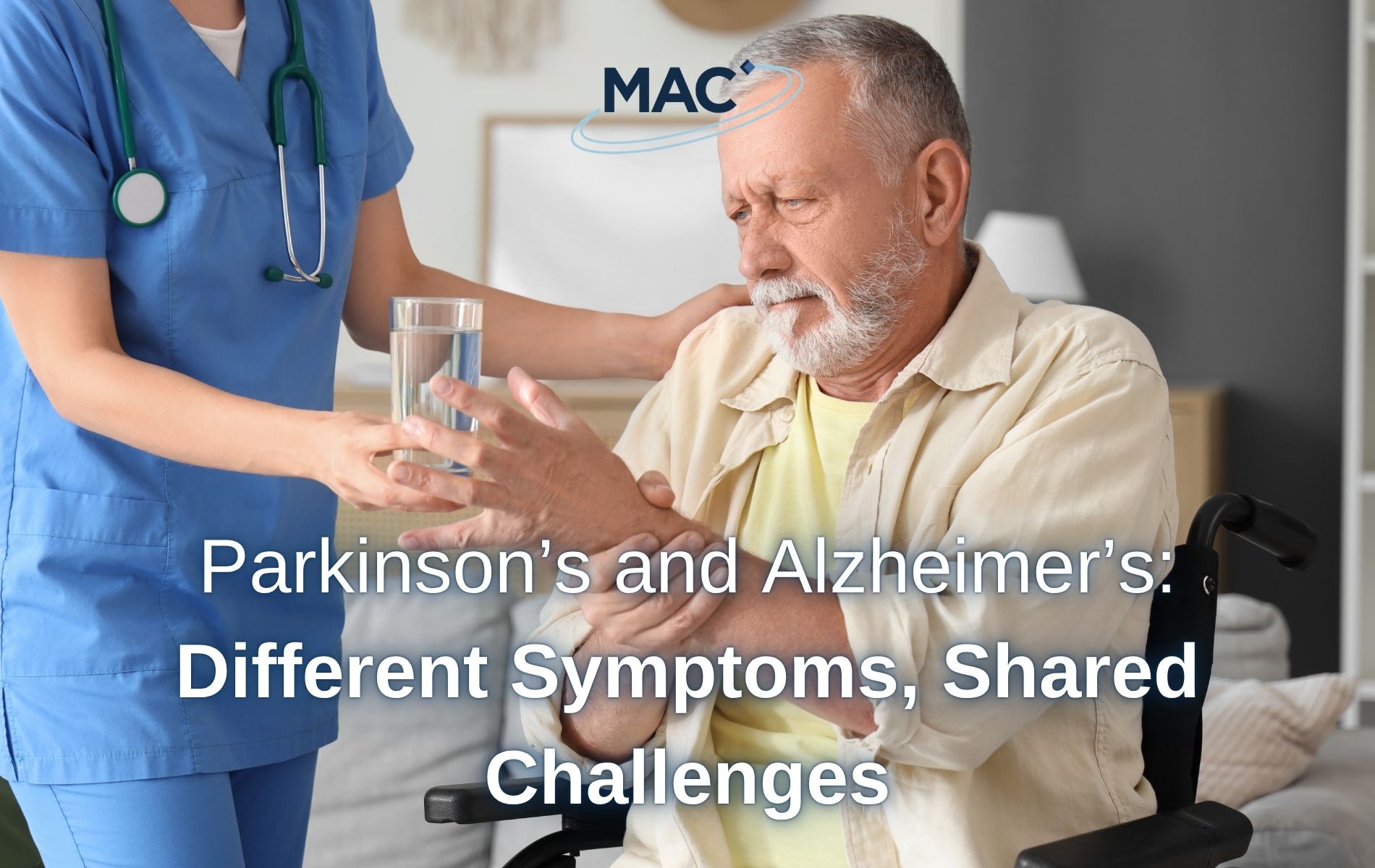
Every year, millions feel the impact of diseases like Parkinson’s and Alzheimer’s, and despite being most well-known for different symptoms, those with the conditions can face similar challenges.
What is Parkinson’s?
Parkinson’s disease is a progressive neurological condition caused by damage to dopamine-producing cells in the brain. Dopamine is a chemical messenger (neurotransmitter) that is essential to controlling smooth and coordinated muscle movements, among other things. As dopamine levels decrease, people with Parkinson’s begin to experience problems with movement, coordination, and other bodily functions.
Typical symptoms include:
- Tremors – this symptom affects around 70 to 80% of people with Parkinson’s1.
- Slowness of movement – this can make everyday tasks take longer.
- Muscle stiffness – this can limit range of motion and cause discomfort.
- Balance and coordination problems – this can increase the risk of falls.
- Posture and gait changes – a shuffling walk and stooped posture are common.
- Changes in mood and behaviour – this can include depression and anxiety.
- Sleep disturbances – this affects around 70% of people2.
What is Alzheimer’s?
Alzheimer’s disease is the most common form of dementia, making up 60 to 80% of cases3. It is a neurodegenerative brain disorder thought to be caused by the abnormal build-up of aggregated proteins (amyloid and tau) in and around brain cells. These deposits cause plaques and tangles to develop, which can start many years before the first symptoms manifest.
Early symptoms are often centred around memory problems, which may look like:
- Forgetting recent events and the names of places or things
- Misplaced items
- Poor judgement and difficulty making decisions
As Alzheimer’s progresses, memory continues to decline, and other symptoms may develop, such as:
- Increasing confusion and disorientation
- Repetitive or impulsive behaviour and changes in mood
- Delusions and hallucinations
- Problems with speech and language (aphasia)
In the later stages, symptoms become more severe, and those with the condition may also experience:
- Difficulty swallowing (dysphagia)
- Weight loss
- Difficulty moving without assistance
- Urinary and bowel incontinence
Shared challenges
Despite their distinct primary symptoms, Alzheimer’s and Parkinson’s share major challenges. In their early stages, managing symptoms on a daily basis can look similar, and as the conditions progress, physical and cognitive symptoms can overlap.
Cognitive symptoms
While one of the first symptoms of Alzheimer’s is known to be memory loss, advanced Parkinson’s also frequently leads to Parkinson’s disease dementia (PDD). PDD is estimated to affect around one third of people living with Parkinson’s4.
Similar to Alzheimer’s, PDD affects attention, problem-solving, language, and memory. This can lead to confusion, changes in mood and behaviour, difficulty recognising loved ones, and challenges with everyday tasks like managing finances and following conversions.
Maintaining a predictable daily routine can help to reduce confusion and anxiety. A schedule can help foster independence and autonomy with everyday tasks.
Physical symptoms
The motor challenges that develop in the later stages of Alzheimer’s mirror the those experienced by people with Parkinson’s. Symptoms like slowness of movement (bradykinesia), muscle rigidity, loss of fine motor control, and postural instability can significantly impact independence.
Those living with either condition may benefit from balance training to help prevent falls, and physical therapy to reduce muscle stiffness.
Help shape future treatments
There is currently no cure for Alzheimer’s or Parkinson’s disease and available medicines are limited. More treatments are needed urgently to slow the progression of these conditions and manage their symptoms.
MAC Clinical Research is currently looking for people living with Alzheimer’s or Parkinson’s to participate in our clinical trials. If you are aged 50 or over and would like to help potentially further treatment options, please visit MAC’s webpages for Alzheimer’s research and Parkinson’s research.
References
1 Parkinson’s Foundation – Tremor
2 National Library of Medicine – Premotor and non-motor features of Parkinson’s disease
3 Alzheimer’s Association – What is Alzheimer’s Disease? Symptoms & Causes
4 Parkinson’s UK – Improving care for people with Parkinson’s-related dementia